


The Artificial Sun on Earth: A New Era of Energy

Experimental Advanced Superconducting Tokamak, or EAST by Hefei Institutes of Physical Science and Chinese Academy of Sciences, is one of the world’s most important fusion research machines. Its purpose is not to recreate the Sun itself, but to demonstrate that humans can confine and control superheated plasma long enough to make fusion energy practical. EAST is a research device rather than a power plant, yet it plays a central role in advancing the science that could one day transform global energy systems.
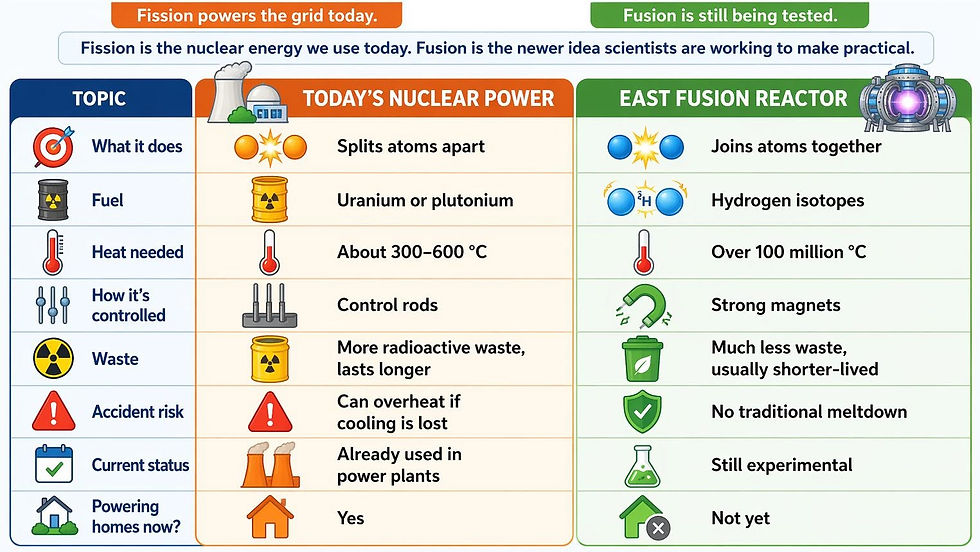
Fusion works by combining light nuclei, usually hydrogen isotopes, under extreme heat and pressure. In a tokamak, this plasma is confined using powerful magnetic fields so it never touches the reactor walls. This method, known as magnetic confinement, is one of the leading approaches toward achieving commercial fusion power.
Unlike conventional nuclear fission reactors, which split heavy atoms such as uranium, fusion joins light atoms together. Fission is already commercially established, but it produces long-lived radioactive waste and carries the risk of severe accidents if cooling systems fail. Fusion, by contrast, produces no carbon emissions during operation and does not carry the same risk of runaway chain reactions. However, it is not entirely free of waste or technical challenges.
A key point often overlooked is that fusion is not only about achieving extreme temperatures. The greater challenge is in maintaining plasma stability, producing sufficient tritium fuel, and developing materials that can withstand intense neutron bombardment over time. Superconducting magnets require cryogenic cooling, while the reactor must also manage extraordinary heat loads. As a result, future fusion systems will contain plasma hotter than the Sun’s core inside equipment cooled to temperatures near absolute zero.

Unlike conventional nuclear reactors, a fusion reactor can be shut down very quickly. In most cases, the reaction stops within seconds because it depends on extreme temperature and precise magnetic confinement. If those conditions are disrupted, the plasma naturally cools and the reaction ceases without the risk of a meltdown.
Fusion also holds strong environmental potential. Its fuel sources are widely available, with deuterium extracted from water and tritium potentially bred from lithium within the reactor itself. Although fusion produces far less long-lived radioactive waste than fission, future plants will still require careful water use, periodic material replacement, and management of short-lived radioactive activation in reactor components.
The significance of EAST lies not in achieving full fusion energy, but in demonstrating sustained plasma control over long durations. This progress represents a critical step toward developing reliable and scalable fusion systems. EAST supports global research efforts rather than supplying electricity to the grid, and its findings contribute to major fusion programs across Europe, Japan, South Korea, India, and the United States.
Despite its promise, fusion remains a highly complex and expensive technology. EAST and similar devices continue to face major challenges, including plasma stability, material degradation, tritium fuel management, and the transition from experimental systems to commercial-scale energy production.
Watch on NASA Space News:
https://www.youtube.com/watch?v=FcZP4_CoYDo
Sources:
The Experimental Advanced Superconducting Tokamak:
https://www.sciencedirect.com/.../pii/S2095809921003933
Chinese nuclear fusion reactor pushes plasma past crucial limit: what happens next:
https://www.nature.com/articles/d41586-026-00063-4
International Atomic Energy Agency (IAEA):
https://www.iaea.org/topics/fusion-energy
U.S. Department of Energy, Fusion Energy Sciences:
ITER Organization: https://www.iter.org
National Academies of Sciences, Engineering, and Medicine: https://www.nationalacademies.org/our-work/fusion-energy
EUROfusion: https://www.euro-fusion.org